
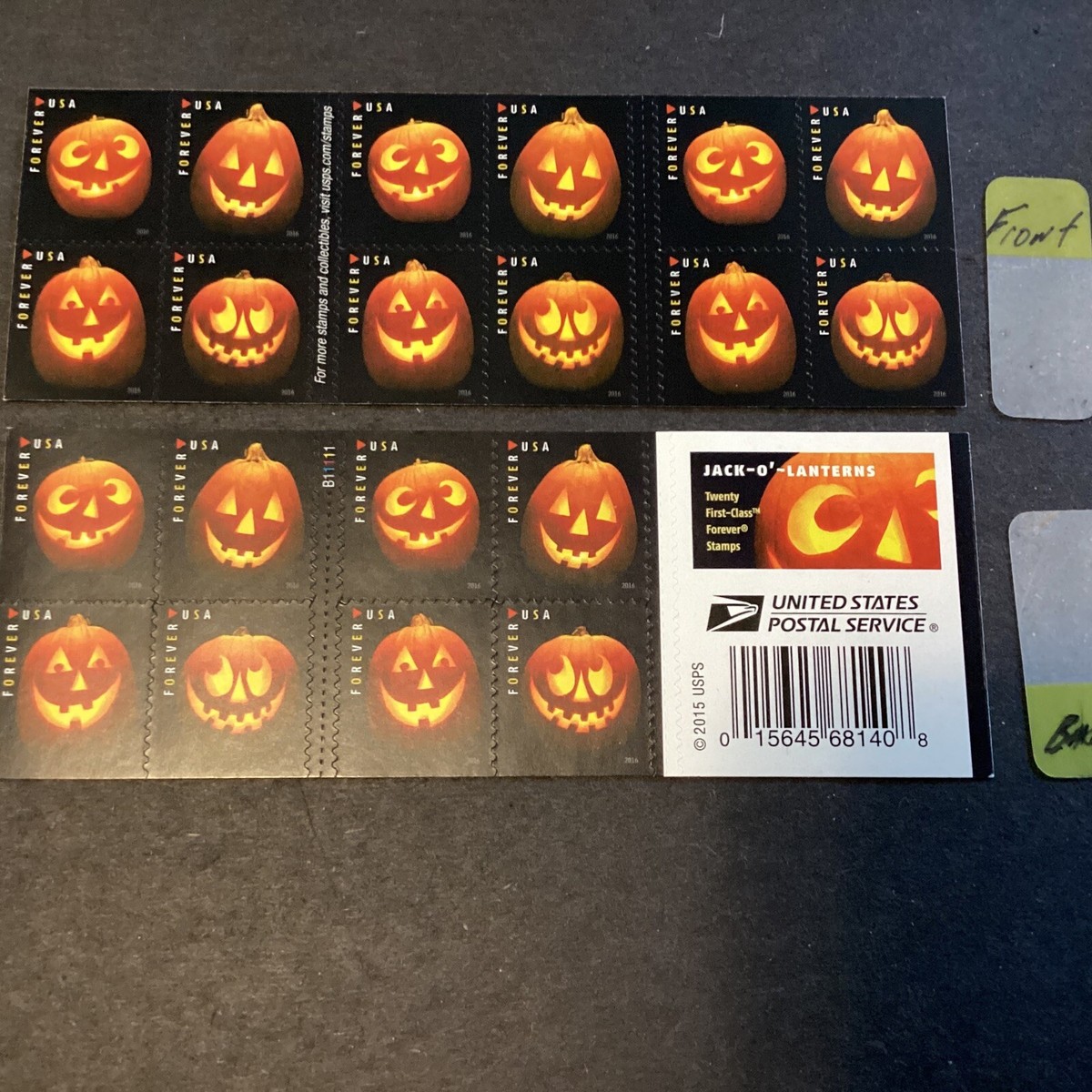
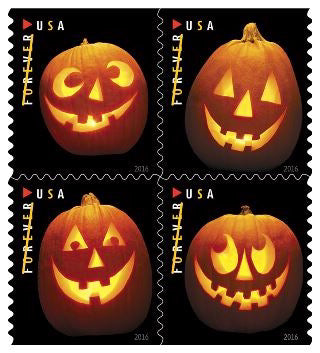
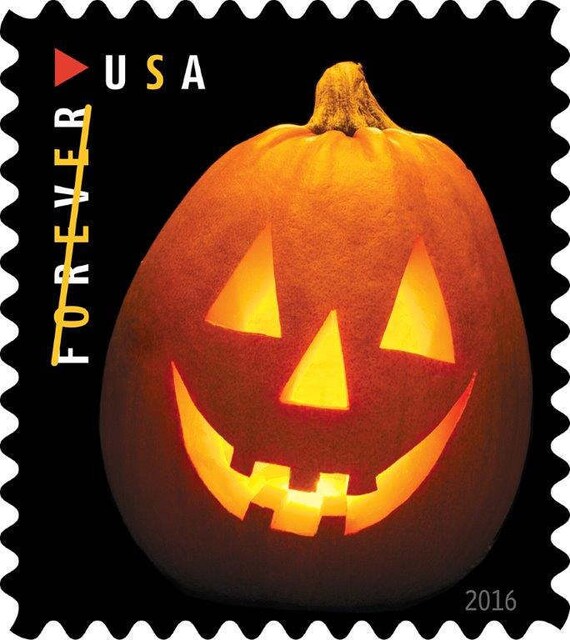
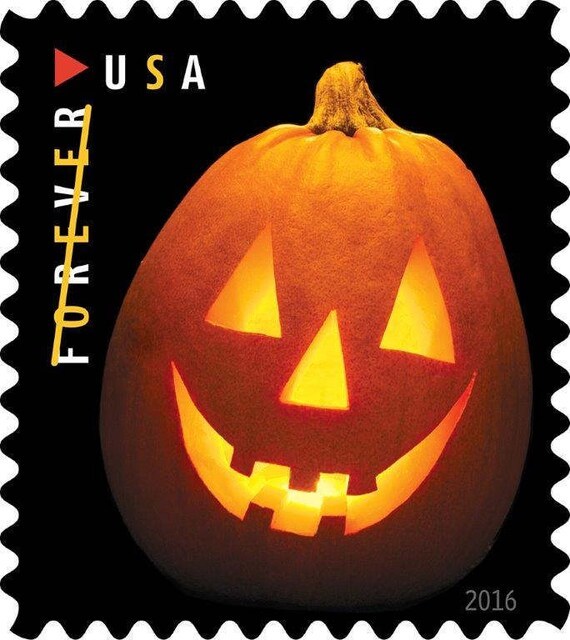
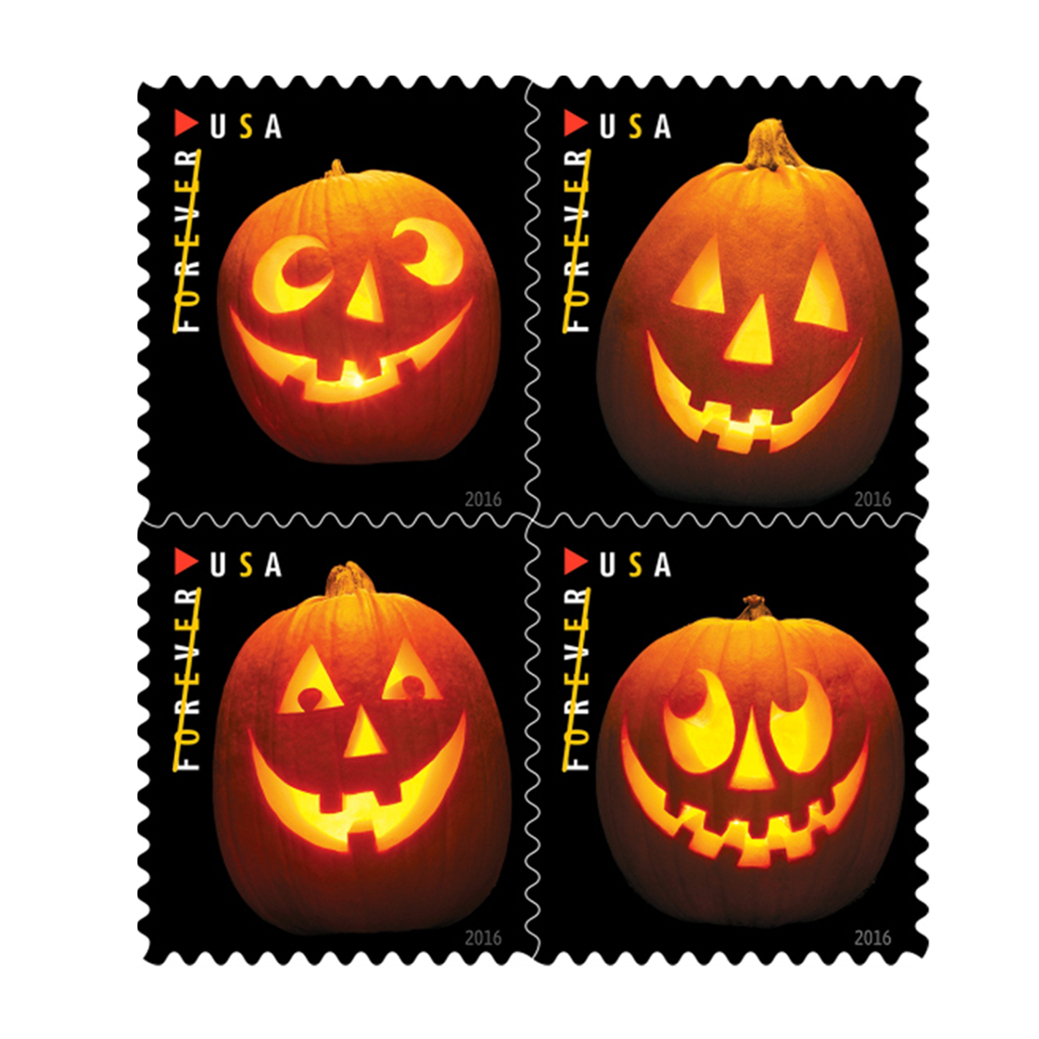
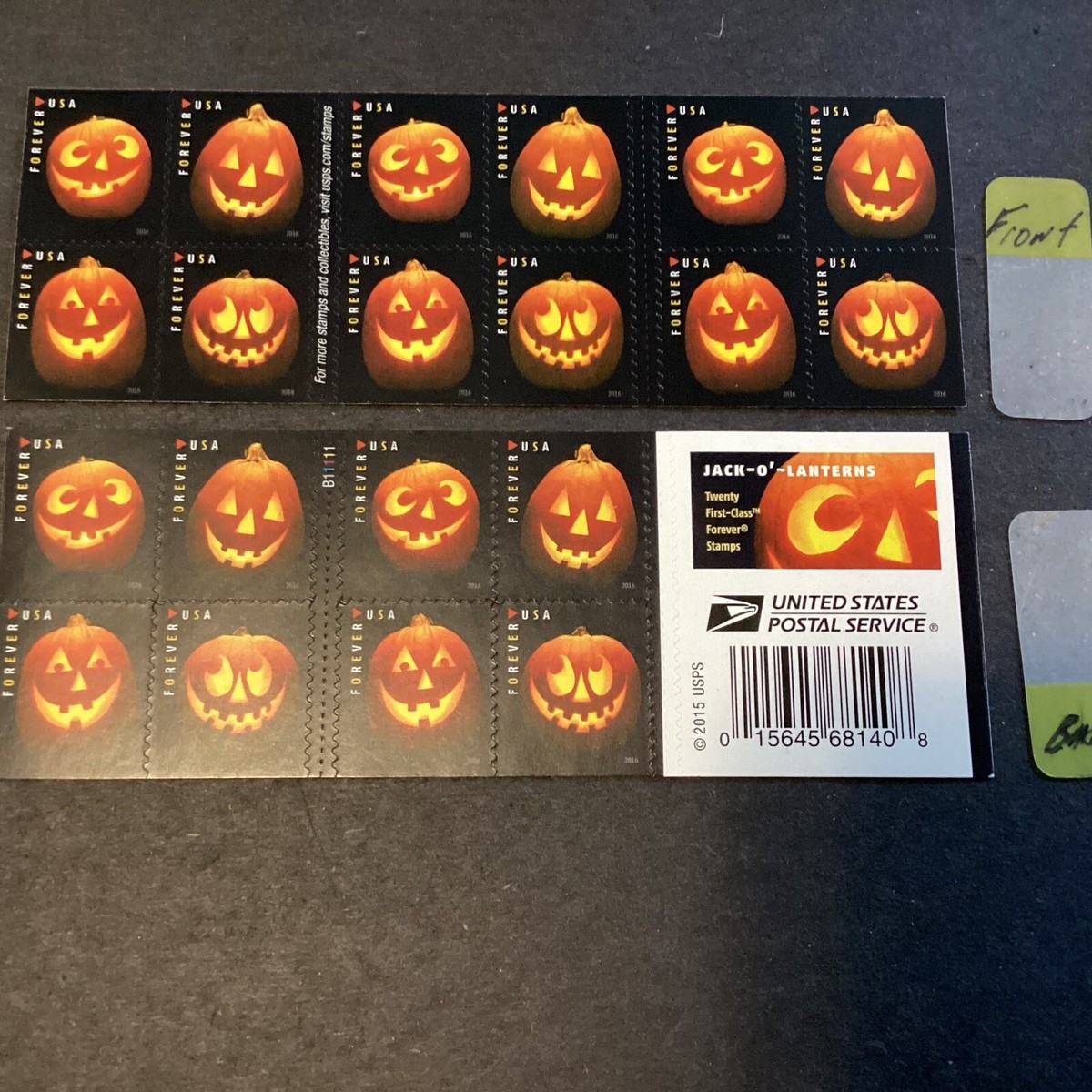
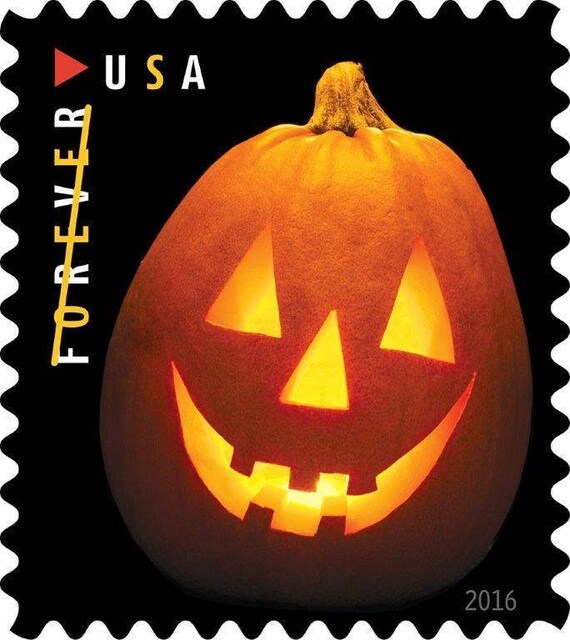
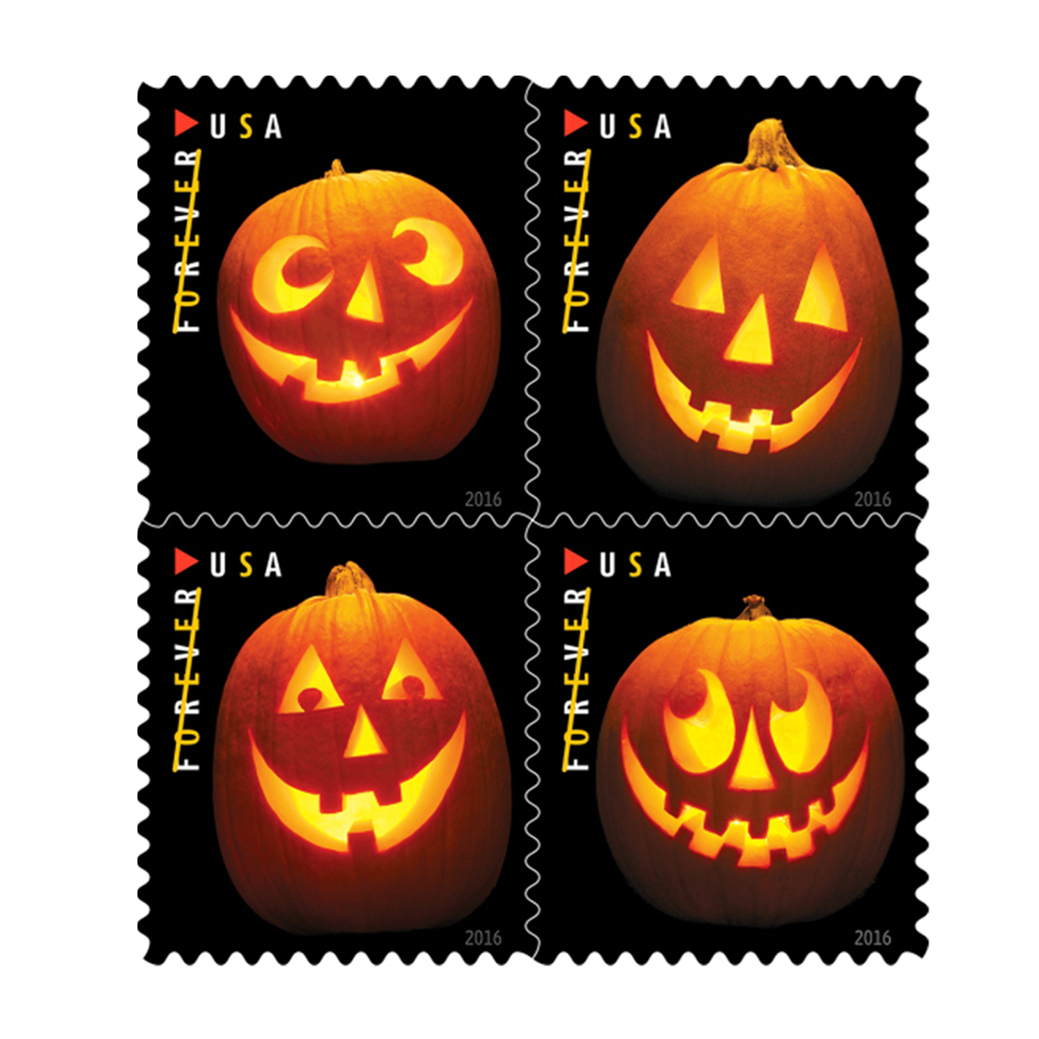
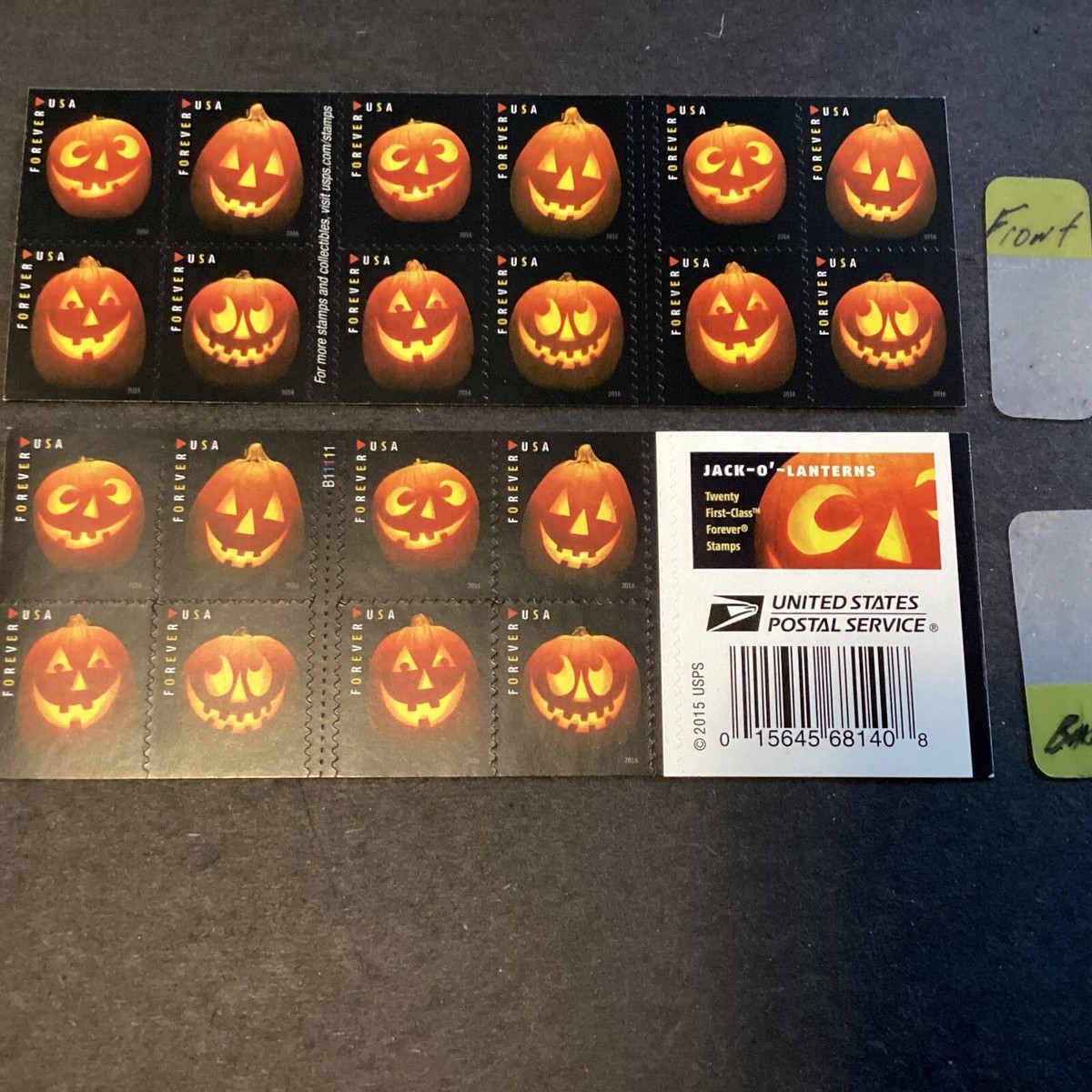
2016 Pumpkin Lights Forever Stamps - Jack-O'-Lanterns

2016 Jack-O'-Lanterns
Issued: September 29, 2016
First Day City: Anoka, MN
Type of Stamp: First Class Mail
Printed by: Banknote Corporation of America
Method: Offset, Microprint
Self-Adhesive
Quantity Printed: 50,000,000
Happy Halloween!
Today we’ll look back on some of the history behind Halloween!
Samhain (Old Irish for “summer’s end”) is often considered to be one of the oldest precursors to Halloween. It’s a traditional Gaelic festival first documented around the 10th century. It is believed modern Jack-o’-lanterns were inspired by a Samhain custom. People would hollow out turnips and carve faces into them to use as lanterns at night.
Samhain was a festival to prepare for winter. It lasted from sunset on October 31st to sunset on November 1st. Huge bonfires were lit as a cleansing ritual, crops were harvested and stored, and animals were moved to winter pastures. It was a celebration to hold people through the long, cold days to come.
Samhain was also believed to be a day when the barrier to the otherworld could be crossed by fairies, spirits, or souls of the dead. Although some spirits were good or the souls of loved ones, others were evil and needed to be warded off. It was said that dressing in disguise and mimicking a spirit would prevent it from harming you. Some of these disguised people went door-to-door singing or reciting verses in exchange for food. Samhain was originally observed in Ireland, Scotland, and the Isle of Man. But its practices have since evolved and spread to other countries around the world.
Christian practices also play a significant role in the history of Halloween. November 1 is All Saints Day and November 2 is All Souls’ Day. It has long been common practice to hold vigils the night before these holy days, so October 31 became known as All Hallows’ Eve. The term “Allhallowtide” was first used to describe the season in 1471.
It was said the boundary between the living and the dead thinned during this three-day period. Some thought they needed to disguise themselves to avoid being recognized by a wayward soul – one possible origin of Halloween costumes. In Poland, people were taught to pray aloud when walking at night to comfort the souls of the dead. Some believed that Jack-o’-lanterns represented souls trapped in purgatory.
November 1st is All Saints’ Day, which celebrates all dead saints and martyrs, while November 2nd is All Souls’ Day and includes all Christians who have died. Different countries have different traditions to celebrate these days. Some prepare offerings of food for their loved ones’ souls. Others lay flowers or wreaths on graves and light candles in the cemetery. Allhallowtide not only remembers the dead but celebrates their lives as well.
According to most accounts, Halloween spread into North America in the 19th century largely due to an influx of Irish and Scottish immigrants. It soon became a major holiday throughout the country and by the start of the 20th century was celebrated coast to coast
How did Jack-o’-lanterns get their name?
The name come from an old Irish folk tale told at Halloween. “Stingy Jack” was a notorious drunk and trickster. Satan heard about Jack’s deeds (rumored to be more evil than his own) and went to see for himself. When Jack met Satan, he asked for one last drink before Satan took his soul. Satan agreed and the two went drinking at a local pub. When it came time to pay, Jack convinced Satan to transform into a silver coin. Instead of paying, Jack put the coin in his pocket next to a crucifix, trapping Satan. Jack only released the devil after he promised not to claim Jack’s soul for 10 years.
After a decade, Satan returned and Jack requested to eat one last apple before going to hell. Satan climbed a nearby apple tree and Jack trapped him again. This time, Jack made Satan agree never to take his soul. When Jack died, he was denied entry to heaven due to his evil deeds. Satan kept his promise and did not take Jack’s soul either. Instead, he threw him an ember from the fires of hell, which Jack put into a hollow turnip to light his way. He was sentenced to roam the Earth for eternity seeking a place to rest. The Irish nicknamed him “Jack of the lantern.” Each Halloween the Irish carved grizzly faces into hollow turnips to ward off the ghost of Stingy Jack.
Frequently Asked Questions
How it works?
A Forever® stamp is for sending domestic mail weighing up to 1 oz via First-Class Mail®.
Purpose: Send letters and cards up to 1 oz (approximately 4 sheets of regular, 8-1/2" x 11" paper in a rectangular envelope)
within the U.S., including U.S. territories and military bases overseas.
Value: Always valid for the First-Class Mail 1 oz rate, even if postage rates increase. Visit First-Class Mail and Postage to view
current rates.
Other Uses: Pair this stamp’s value with other postage to meet mailing costs when additional postage is required.
Use the Retail Postage Calculator to determine the exact cost of your mail.
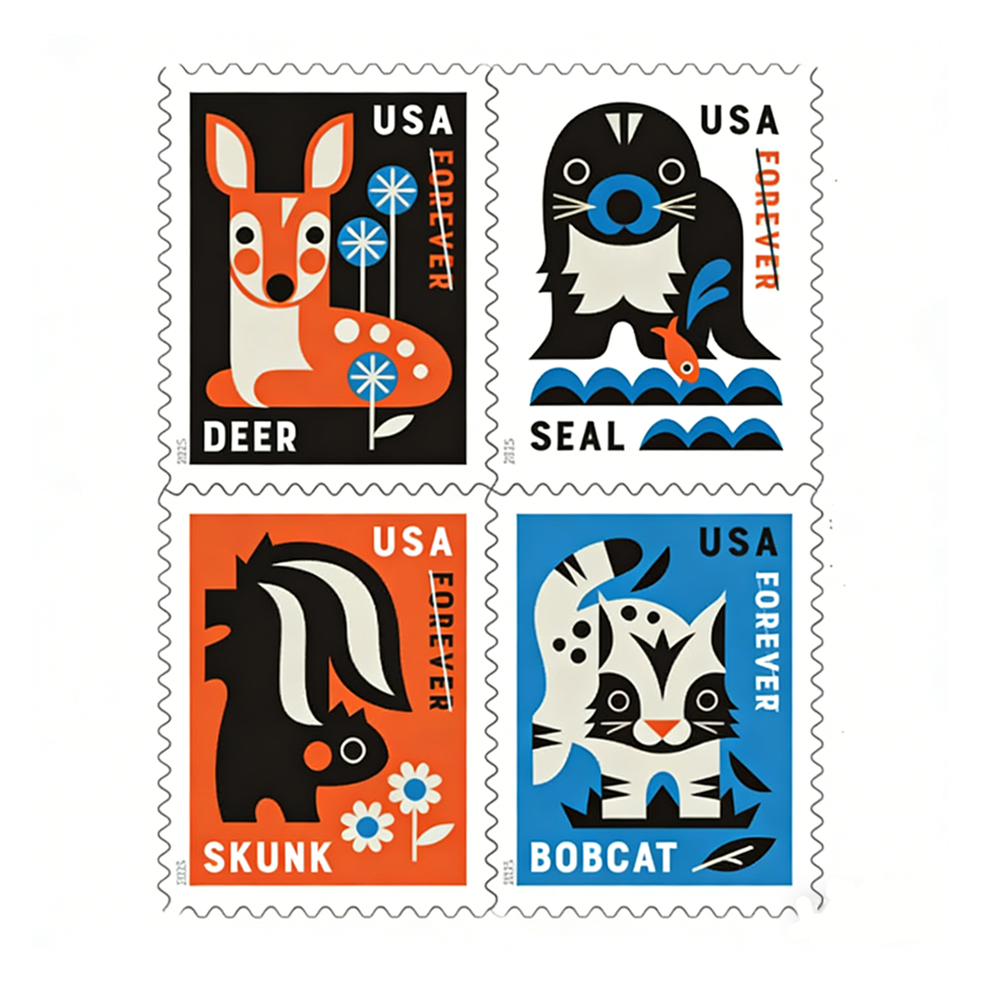
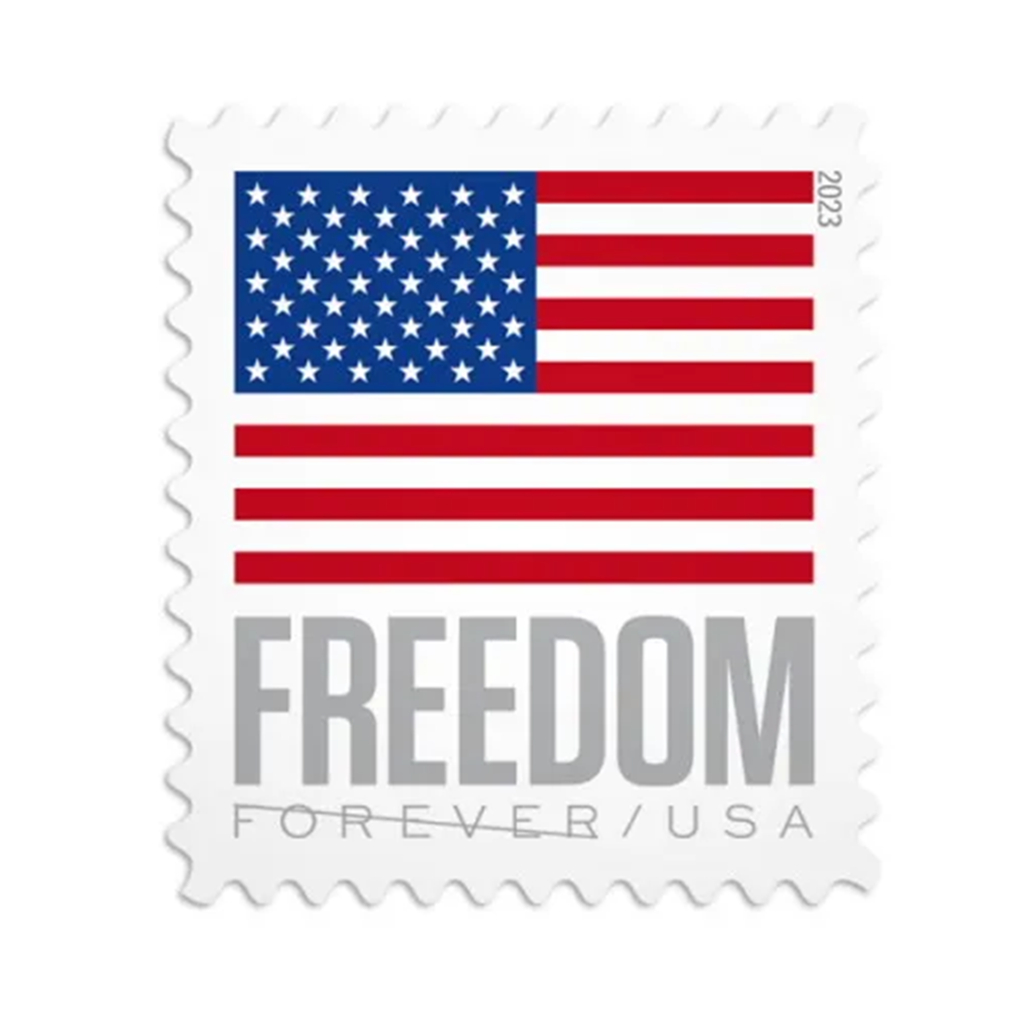
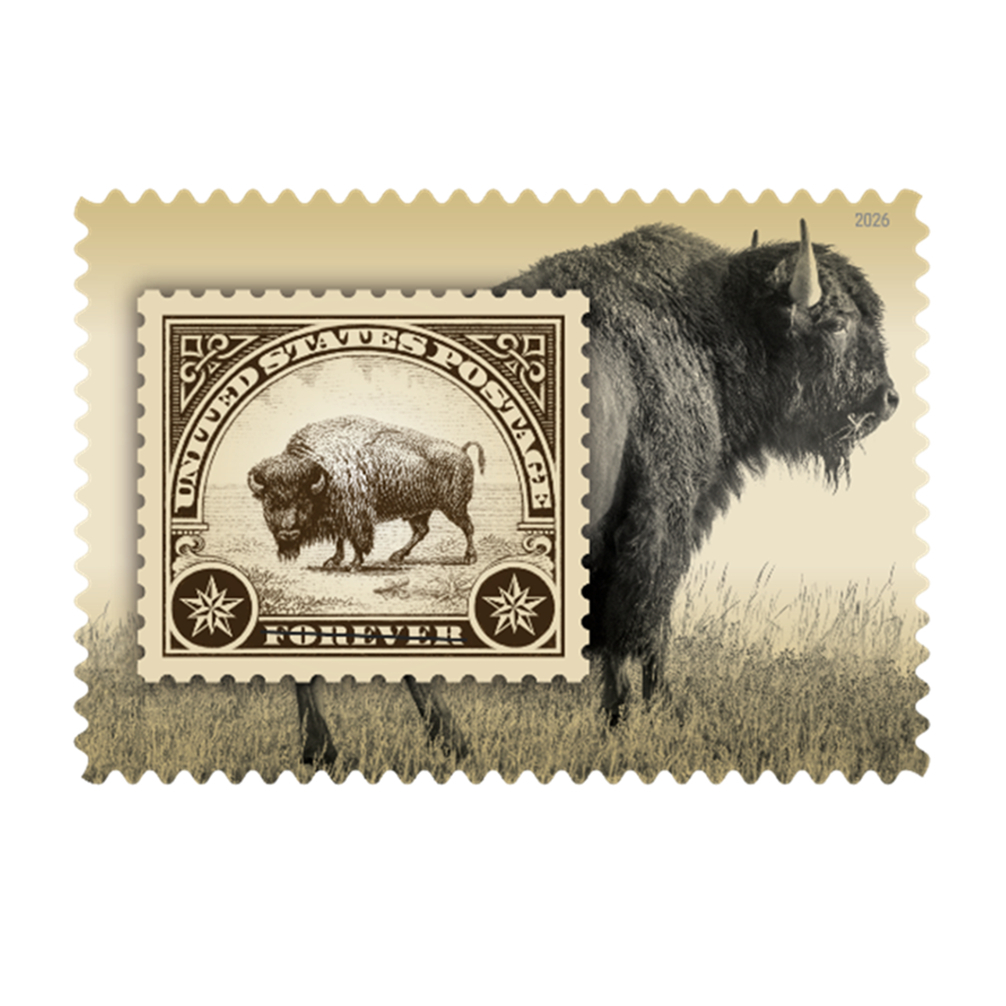
Why is "FOREVER" crossed out in the image?
So the lines in your picture:
- It does not mean that the stamp has expired;
- It does not mean that you cannot continue to use it;
- Nor a postmark;
- It's just an artificial anti-copying line added to the display image.
Note: If the physical stamp you receive actually has this crossed line printed on it, be cautious. It may be a display sample, a replica or a fake stamp, rather than a normal usable stamp.
What are the common types of stamps, and how do they differ?
- Forever Stamp: Valid for standard domestic letters within the U.S. These stamps typically do not bear a fixed face value; they remain valid for mailing a standard one-ounce letter at the current rate, even if postage prices increase in the future.
- Global Forever Stamp: Primarily used for standard international letters or postcards sent from the U.S. to other countries. The main difference between this and a standard Forever Stamp lies in its scope of use and postage value.
- Postcard Stamp: Designed specifically for domestic postcards that meet USPS size standards; the postage rate is typically lower than that for standard letters.
- Additional Ounce Stamp: Used to cover the cost of weight exceeding the first ounce; these are usually used in conjunction with a Forever Stamp or other stamps.
- Two-Ounce and Three-Ounce Stamps: Suitable for heavier letters, greeting cards, wedding invitations, or multi-page documents, eliminating the need to combine multiple stamps to cover the required postage.
- Fixed-Value Stamps: These stamps display a specific monetary value (e.g., 1¢, 5¢, or other amounts) and are primarily used to make up postage differences or in combination with other stamps.
- Commemorative and Thematic Stamps: Typically issued to mark historical events, cultural or artistic themes, holidays, notable figures, animals, or natural landscapes. While suitable for regular mail, these stamps are also popular among collectors due to their unique designs and limited release periods.
It is important to note that a stamp's theme and its postage class can overlap; for example, a holiday-themed stamp might also be a Forever Stamp. When purchasing, check for markings such as FOREVER, GLOBAL, POSTCARD, ADDITIONAL OUNCE, or a specific face value to confirm the stamp's intended use.
Can I partner with StampResale for wholesale?
- Business inquiries: sales@StampResale.com
- (This email address is for business inquiries only and does not handle after-sales service. For order processing, please contact the email address in the menu.)
Why choose StampResale.com?
- At StampResale, you will find a diverse range of U.S. stamps—including classic Forever Stamps, holiday-themed issues, commemorative stamps, and specialty collections—catering to needs ranging from everyday mailing and gift-giving to serious collecting.
We also frequently offer limited-time discounts, bundle deals, and exclusive promotions, providing you with a wider selection and greater value while guaranteeing the authenticity and quality of our stamps.
MAYBE YOU LIKE THESE
-
2026 American Bison First-Class Forever Stamp
2026 American Bison First-Class Forever Stamp
$7.99 USD $14.30 USD